The Ferry Landing Where Melbourne Beach Began Is Now Where It Does Sunset Yoga
August 13, 2026
August 13, 2026
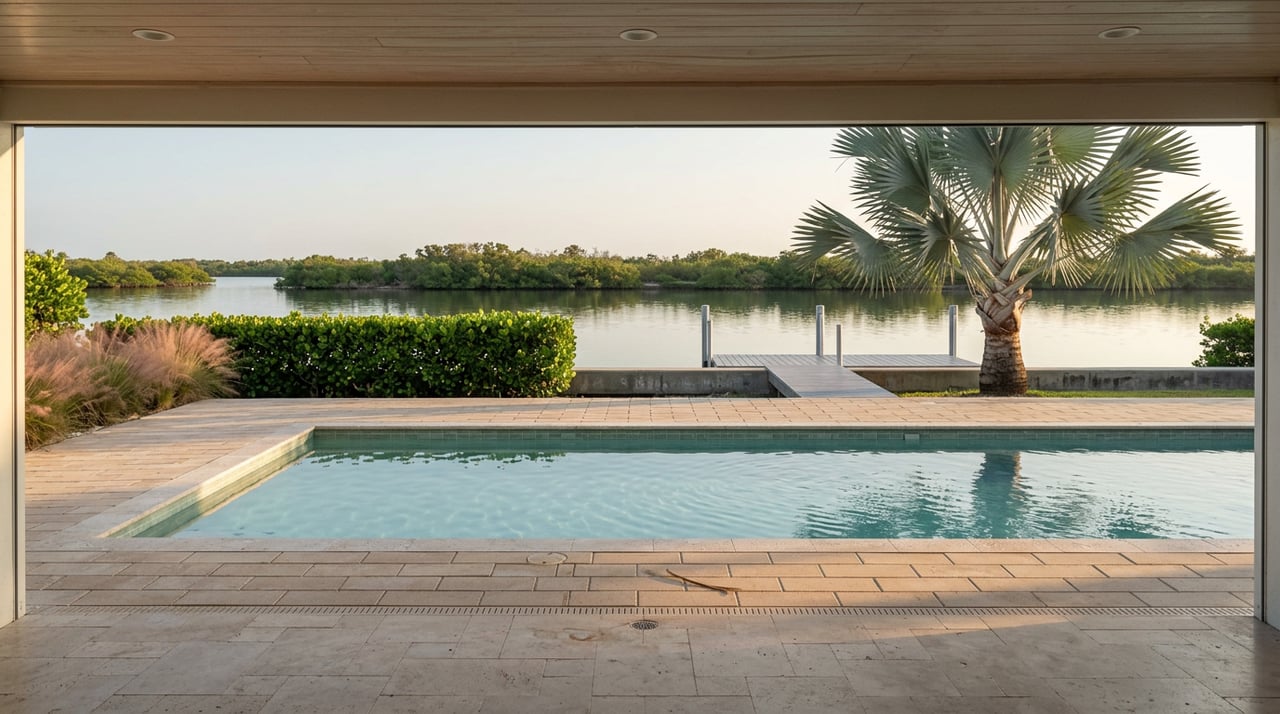
On a Tuesday evening a little before six, mats start unrolling on the grass where Ocean Avenue bends into Riverside Drive. The Indian River is going flat and gold behind them. Across the street, the lot at Djon's Steak and Lobster House is filling up for early dinner. A few fishing lines are already out on the pier, tips bobbing in that particular way that means someone's caught something small and is deciding whether it's worth reeling in. This is Ryckman Park doing what it has done, in one form or another, since before Melbourne Beach had a name.
That's not a metaphor. It's a fact about the ground itself. The spot where people now gather for free sunset yoga is the exact spot where the town's first ferry used to dock, where its first post office opened, and where its first town hall stood. The park hasn't been preserved as a museum piece next to a working town. It IS the working town. It just changed its clothes.
Before there was a Melbourne Beach, there was a ferry crossing. Captain Rufus Beaujean, a carpenter who'd arrived on the barrier island in 1888, built a small wooden cottage here for his family, then ran the ferry that connected the island to the mainland. The historical marker for the Ryckman House lays out what came next: Beaujean built the house itself in 1890 for an investor named Jacob Fox, using native pine and cypress hauled in on a vessel called the Frost Line. It had no electricity. Water came from an artesian well the development company had drilled. Fox and his family spent seasons here, and the handful of other residents, fewer than 20 people by 1891, treated the place as both home and headquarters.
The pier came first, built over the winter of 1888 and 1889 by the rail company backing the new settlement, named as the Melbourne and Atlantic Railroad Company in some accounts and the Indian River and Atlantic Railway Company in others. Sources also differ on exactly how long it ran into the lagoon, some put it at around 300 feet, a Vero Beach news account calls it 650, but everyone agrees on what it did: it was the only way in. Ferries and the occasional steamship tied up there, and from the pier's east end a small pushcart railroad, later motorized, ran seven-tenths of a mile straight to the Atlantic side so visitors could get to the ocean without walking through scrub. That track is gone now. Ocean Avenue runs where it used to.
By 1891, the Beaujean cottage was doing double duty as the settlement's first post office, with Rufus Beaujean as postmaster. A replica of that cottage still stands in the park today. So does the Ryckman House, which took its current name in 1908 when a New York vintner named Garrett Ryckman bought it. His daughter Ruth lived there into old age and left the house to the Town of Melbourne Beach when she died in 1979 at 89.
Just up the road, the Community Chapel was built in 1892 on land donated by Henry Whiting, on the condition that it remain nondenominational forever. A guide named Thomas, leading a walking tour documented by Vero News, described rebuilding the Beaujean cottage replica back in 1991 after finding its remains nearby: "We rebuilt this in 1991." The chapel isn't a museum stop either. Couples still get married there.
Here's the detail that makes the continuity argument for you: the original Town Hall, built in the early 1900s by the Melbourne Beach Improvement Company, stood on what's now the park grounds. When the town needed a new one in 1953, it didn't tear the old building down. It floated it down the river to a new location on Oak Street, where it still stands at 2373 Oak St, now rehabilitated as a history and events space that the town keeps open to the public. According to the Town of Melbourne Beach's own events page, that hundred-year-old building is still doing civic work, just relocated a few blocks inland.
That's the pattern here, over and over. Nothing gets demolished. It gets moved, renamed, or repurposed, and it keeps working. The ferry landing became a fishing pier. The post office became a history exhibit. The town hall floated to a new address and kept its job. Ryckman Park isn't an exception to how Melbourne Beach handles its old buildings. It's the clearest example of it.
If the 1889 version of this ground existed to bring the whole tiny population to one place at a set time, the current version does the same thing on a schedule you can actually plan around. As of this summer, the recurring free programming at Ryckman Park runs roughly like this:
None of this requires registration or a fee. It's the kind of programming that only makes sense in a town small enough that a handful of instructors can carry the whole calendar, which is itself a small piece of evidence for how little Melbourne Beach's population math has changed since the Beaujean days, even if the count is bigger than 20 now.
The park's popularity created a problem the 1889 version never had. Parking along Ocean Avenue is metered now, with numbered spaces and a pay station. Rates depend on who you ask and when they last checked, somewhere between roughly $2 and $4 an hour, with a flat cap around $20 for a full five-hour stretch. One longtime visitor described showing up for a yoga class after a year and a half away, parking at the curb out of habit, and coming back to a ticket because there had been no meter there thirty years of visits ago. The town does offer an annual parking pass for residents, which is the detail worth knowing if you're planning to make this a weekly habit rather than an occasional stop. Nobody wants to pay for the pier twice: once in taxes and once in citations.
Look up from a yoga mat in Ryckman Park and you're looking at a small cluster of buildings that all predate the state's tourism boom. The Ryckman House sits a few dozen yards away. Across Ocean Avenue, the former Villa Marine Hotel, built in 1912 and 1913 from concrete blocks made with sand dug up on site, now houses a dentist's office. Djon's Steak and Lobster House anchors the corner where locals actually eat, not the version built for a highway exit. A short walk puts you at Black Dog Bait and Tackle if the fish are biting off the pier, or Nautical Collections Shells & Gifts if you're headed home with a grandchild who wants a souvenir that isn't plastic.
None of this reads like a preserved district performing its own history for visitors. It reads like a town that kept using its old infrastructure because the infrastructure still worked, the same way a fishing pier built for ferries in 1889 still works for people who just want to watch the sun go down over the lagoon on a Tuesday.
That's the thing about Ryckman Park that a quick visit doesn't tell you. It isn't old and it isn't new. It's the same shared landing point the town has always had, still doing the one job it was built for: getting everyone in Melbourne Beach to the same stretch of riverbank at the same time.
If you already call this stretch of the barrier island home and you've ever wondered what your own slice of it is worth in today's market, Milly Akins offers a free home valuation and knows this block, pier post by pier post. Get your free home valuation whenever you're ready to talk.
Stay up to date on the latest real estate trends.


Milly is active in her community, loves spending time with her family and Belgian Malinois, and believes in helping others. She works with both buyers and sellers and is ready to show you what a seamless real estate experience feels like.